Description
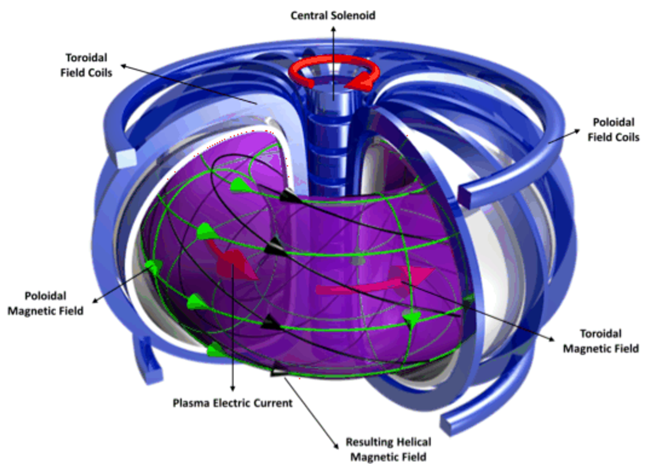
Proper design of power converters is crucial for applications requiring precise current control, especially in high-current scenarios (tens of kiloamperes) such as plasma confinement and particle acceleration. These applications demand multiple power supplies to accurately energize inductive loads, which exhibit complex and time-variable behaviors due to interactions within the system. A notable example is the Vertical Stabilization (VS) coils in tokamaks, which have frequency-dependent resistance and inductance (RL) characteristics. Effective testing of the power supplies, or Devices Under Test (DUTs), necessitates a Load Emulator (LE) capable of replicating such dynamic behaviors. A Load Emulator (LE) simulates electrical loads to assess system performance under controlled conditions. Given the complexity of high-current applications, Power Hardware-In-the-Loop (PHIL) systems are widely adopted. PHIL consists of a Real-Time System (RTS) simulator, which models the target load, and a power amplifier that interfaces with the DUT. Various control strategies, including hysteresis switching and PID controllers, have been explored for PHIL-based load emulation. However, existing PHIL solutions primarily focus on grid emulation, achieving high voltage but lacking high-current capabilities and real-time adaptability to frequency-dependent RL characteristics. The study will focus on investigating Power Hardware-in-the-Loop (PHIL) and Load Emulators (LE) for high-current applications. It will aim to identify DUT testing requirements and analyze gaps in literature, particularly in reproducing complex loads via Real-Time Systems (RTS) and designing high-speed power amplifiers. A low-power setup and a scaled-down prototype will be used to finally validate results.